
When nurses care for too many patients at once, patients are more likely to die. That finding has held up across two decades of research, in the US and in Europe. For hospital leaders, it means staffing levels are a patient safety decision, not only a budget line.
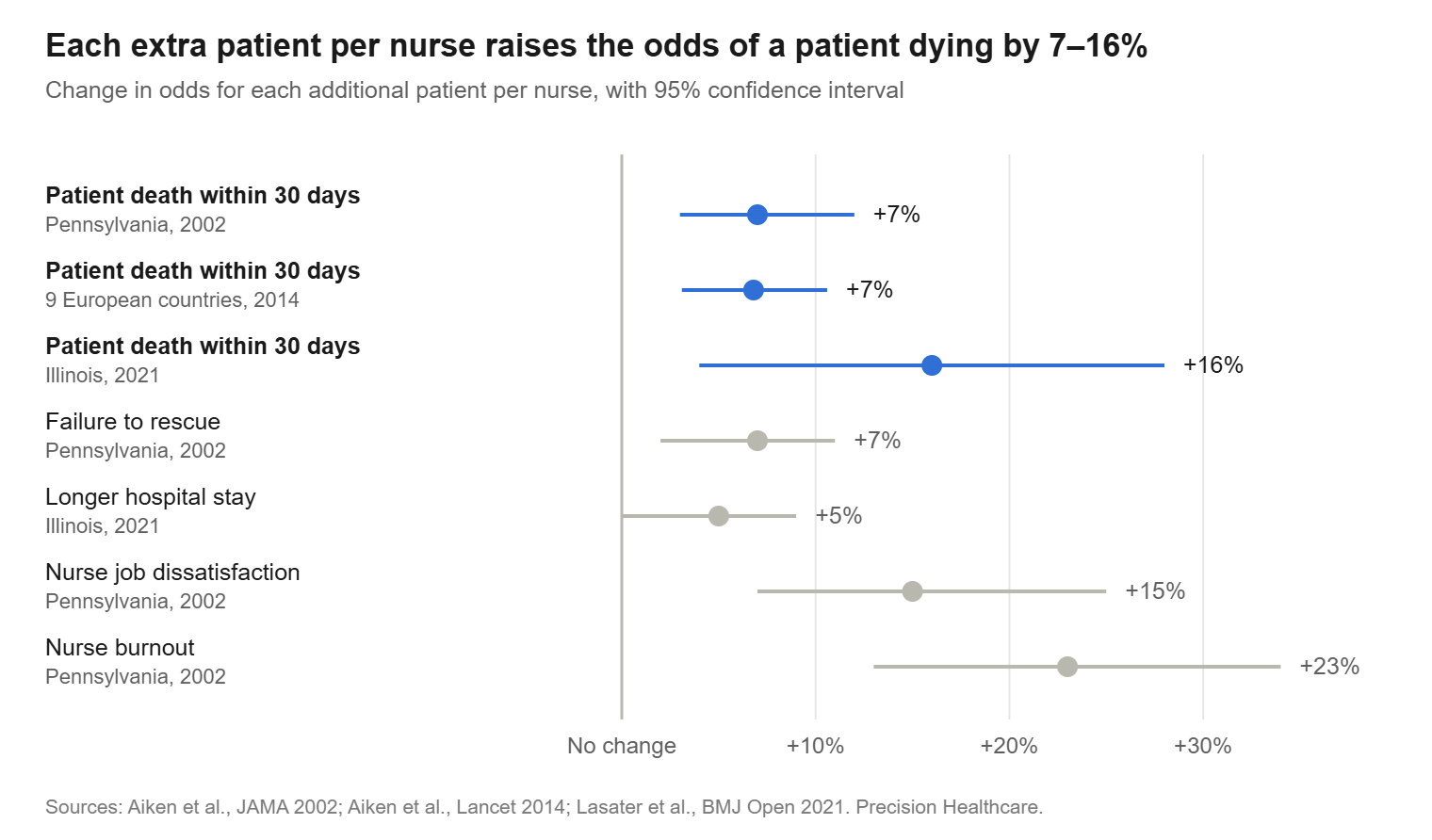
What the major studies found
- Pennsylvania, 2002: a study of 168 hospitals, about 10,000 nurses and more than 232,000 surgical patients found that each additional patient per nurse raised the odds of a patient dying within 30 days by 7%. Nurse burnout odds rose 23% and job dissatisfaction 15% (Aiken et al., JAMA).
- United States, 2011: in a large academic medical center, every shift staffed 8 or more hours below target, and every shift with high patient turnover, raised patients’ risk of death (Needleman et al., NEJM).
- Nine European countries, 2014: each extra patient per nurse raised the odds of death within 30 days by 7%. Every 10% increase in nurses with a bachelor’s degree lowered those odds by 7% (Aiken et al., Lancet).
- Illinois, 2021: across 87 hospitals, medical-surgical units averaged 5.4 patients per nurse. Each additional patient raised the odds of death within 30 days by 16%. The authors estimated that staffing at 4 patients per nurse would have avoided more than 1,595 deaths and saved over $117 million in one year (Lasater et al., BMJ Open).
Why staffing affects outcomes
Nurses are the people who notice when a patient is getting worse. With too many patients, checks happen less often, early warning signs are missed and there is less time to act. That is why “failure to rescue”, a death after a complication that could have been caught, rises with workload too.
Understaffing also drives nurses out. Burnout and dissatisfaction lead to turnover, which leaves units shorter staffed and more dependent on new or temporary staff.
What hospital leaders can do
- Track shifts below target, not only averages. A unit can look fine on average while running short several shifts a week.
- Staff to acuity, so sicker patients get more nursing time.
- Plan for peaks and vacancies before they happen, with float pools, per diem staff and a staffing partner on standby. Our guide to building a nurse staffing plan covers this step by step.
- Invest in skill mix, including experienced and bachelor’s-prepared nurses on every shift.
- Watch burnout signals such as overtime, sick calls and turnover, before they become vacancies.
How Precision Healthcare helps
Precision Healthcare supplies contract, contract-to-hire and permanent nurses so hospitals can keep units at safe staffing levels through vacancies, leaves and seasonal peaks. Contact our team to talk about your staffing gaps.
Frequently asked questions
Does nurse staffing affect patient mortality?
Yes. Major studies in the US and Europe found that each additional patient per nurse raised the odds of a patient dying within 30 days by 7% to 16%.
What is a safe nurse-to-patient ratio?
It depends on the unit and how sick the patients are. Some states set legal minimums; the Illinois study modeled 4 patients per nurse on medical-surgical units.
Does understaffing affect nurses too?
Yes. In the Pennsylvania study each additional patient per nurse raised the odds of burnout by 23%.